Friday, December 17, 2021

You’d Want to Live


Saudi Arabia Wants Its Capital to Be Somewhere You’d Want to Live

The crown prince’s next grand plan is to defy the skeptics and turn Riyadh into a greener, cooler city for twice the population. 

By 
Vivian Nereim
December 16, 2021

https://www.bloomberg.com/news/features/2021-12-16/saudi-crown-prince-mbs-s-vision-imagines-a-greener-bigger-riyadh


On Riyadh’s King Abdulaziz Road, construction workers sweep sand off a brand-new sidewalk. A gardener pops a spindly plant out of a plastic pot and gives it a new home in the ground, smoothing the soft red earth with his hands.

Behind them, 15-foot-high banners advertise the future gardens and canals of King Salman Park, a plan to turn an air base in Saudi Arabia’s desert capital into a public green space four times bigger than Central Park in New York.  

Saudis have gotten used to breakneck change over the past five years under Crown Prince Mohammed bin Salman, whether it’s the shock therapy to turn the kingdom into a post-oil economy, a high-tech city from scratch on the Red Sea or the loosening up of society that allows men and women to mix more freely. But among the most ambitious plans is to transform Riyadh — one of the world’s most sprawling, car-dependent and water-poor cities — into a paragon of sustainability.

That means spending tens of billions of dollars of oil revenue on re-engineering life for the city’s 8 million residents, adding sidewalks, public transportation, electric vehicles, neighborhood parks and millions of trees.  

The goal is to green the capital enough to lower its ambient temperature by 2 degrees Celsius (3.6 degrees Fahrenheit), giving the city a cushion against climate change in a region where summer temperatures exceeding 110 degrees Fahrenheit are already common.

If that doesn’t sound challenging enough, Prince Mohammed also wants to double Riyadh’s population in 10 years, turning what was a relatively conservative city even by Saudi standards into a regional business hub that can compete for talent with Dubai. It would be difficult to attract the highly-educated foreigners he wants to move to Riyadh without making the city more livable. 

“The idea is very simple: reduce sprawl and ensure density in the city is increased,” said Fahd Al-Rasheed, head of the Royal Commission for Riyadh City, charged with implementing the plan. “The city is built already for that kind of capacity — it’s double the size of Singapore.”

Skeptics abound, of course, at home and abroad. Saudi Arabia is the world’s largest crude exporter and has the highest carbon dioxide emissions per capita among the G-20 nations. 

The crown prince’s blueprint for his country’s future, called “Vision 2030,” calls for new industries from entertainment to defense and a complete overhaul of the economy. Yet the country’s fortunes still rise and fall with oil and the prince has been trying to rebuild his reputation among foreign investors after Saudi security forces murdered Washington Post columnist Jamal Khashoggi in 2018.

There are also the practicalities of making Riyadh the nerve center of the new Saudi Arabia: the city’s population has already exploded 50-fold since 1950, gridlocking its streets and guzzling its limited water supply.

“The key issue for me when you hear about these very ambitious strategies and proposals is whether that really constitutes a massive change, or is it just sort of window dressing — kind of green washing,” said Yasser Elsheshtawy, an adjunct architecture professor at Columbia University who focuses on Arab cities.  

Indeed, previous attempts to remake Riyadh fell short of their targets, including a city development strategy 20 years ago that called for many of the same changes as today.

But if officials succeed even partially, Riyadh will offer the world a case study on how urban areas can adapt to rising temperatures and water shortages.

“I doubt if there is a much harsher environment than what we have here,” said Saleh Al-Hathloul, a Saudi architect and former town planning official. “If we can do it, then it can be done anywhere.”

Riyadh’s problems are partly a legacy of its rapid growth. When Al-Hathloul moved to Riyadh in the 1960s, it was still possible to walk from one side of town to the other. Before the oil boom transformed the kingdom, residents typically lived in traditional mud houses along narrow shaded pathways.

Over the next few decades, Saudi Arabia was one of the fastest-urbanizing countries in the world. International planners including the Greek architect Constantinos Doxiadis were brought in to shape the capital as builders struggled to keep up with demand.

Riyadh became a city of wide avenues that baked in the sun. Today, the lushest landscapes are hidden inside royal palaces and private homes. Sidewalks are disjointed or nonexistent; life without air conditioning is almost unthinkable. Sometimes you need to call a taxi just to cross the street.   

“It’s like you had your grandmother’s recipe that came throughout the generations and you started to go to McDonald’s and you forgot how to do that,” said Abdulelah Alsheikh, a former bureaucrat who helped draft the strategy in 2001. He’s now the country head of engineering firm Jacobs. “We’ve lost our way maybe, and those skills need to be brought back.”

To do that, Al-Rasheed, the official in charge of Riyadh’s makeover, wants to halt the city’s endless spread north into the desert and start building denser, taller and greener.

A $92 billion sustainability strategy aims to cut Riyadh’s carbon emissions in half. It calls for planting 15 million trees and boosting the use of treated water for irrigation from 11% to 100%. Officials plan to mandate that 30% of all vehicles in the city be electric by 2030. A nearly finished metro system could carry 4 million people a day.  

“You increase the amount of sewage treatment and use that water to actually green the city. You lower temperatures, that lowers the need for air conditioning,” said Al-Rasheed. "It’s a system-based thinking.”

In Al-Rasheed’s vision, the future Saudi family might live in an an apartment instead of a villa, spending leisure time in a park instead of their backyard. That’s a shift for a culture that values privacy highly and will require a new mentality and way of life, said Mashary Al-Naim, an architecture professor at Imam Abdulrahman bin Faisal University in Dammam.

That rethink puts Riyadh in the company of cities from Miami to Bangkok that are grappling with how to adapt to climate change. Copenhagen is aiming to be the world’s first carbon-neutral capital by 2025. Tokyo’s 2016 environmental master plan calls for reducing greenhouse gas emissions by 30% and new measures to combat summer heat waves.

None of them are aiming to double their population, though — a target that’s left many Saudis aghast, even as they dream of a more livable future for their capital.

“The main problem here is these initiatives are always top-down, which sort of precludes the input of people,” said Elsheshtawy, the Columbia professor. “There is a disconnect between policies that are being implemented and then how they are actually being carried out on the ground.”

Some Saudi urban planners are hopeful that the new Riyadh will succeed this time because it has the full weight of the monarchy behind it. But sometimes the emphasis on a grand vision can overshadow smaller measures that could have a big impact on quality of life, several of the planners and architects said.  

Alsheikh gave the example of Wadi Hanifah, a verdant valley that weaves through Riyadh. It was once a garbage dump and source for construction materials. A program to rehabilitate it took decades to turn it around.

On a recent balmy weekend, cyclists and pedestrians made their way along dirt paths. Birds chirped and smoke wafted from grills as families laid out blankets for picnics.

“Now it’s beautiful,” Alsheikh said. “But when people see it and experience it, they don’t know how much it took.”

Thursday, December 16, 2021

I Quit...!


8 mistakes leaders make that cause their employees to quit
Setting Inconsistent Goals
There are a lot of limitations
Waste of resources
Recruiting people in the wrong positions
Customize boring or easy missions
Failure to create a safe culture
Create a highly secure work environment
Partial leadership

أخطاء يرتكبها القادة تؤدي إلى استقالة موظفيه
تحديد أهداف غير متسقة
هناك الكثير من القيود
مضيعة للموارد
تجنيد الأشخاص في الوظائف الخاطئة
تخصيص المهام المملة أو السهلة
عدم خلق ثقافة آمنة
خلق بيئة عمل آمنة للغاية
القيادة الجزئية

Friday, December 10, 2021

Reduced or Induced Demand


Proposed I-375 "boulevard" in Detroit. Source: Michigan DOT.

Reduced demand is just as important as induced demand

It's time to use the idea of reduced demand where it has the potential to improve a city's economy, society, and mobility.

Note: Public Square editor Robert Steuteville is on vacation this week, and some popular past articles are being featured.

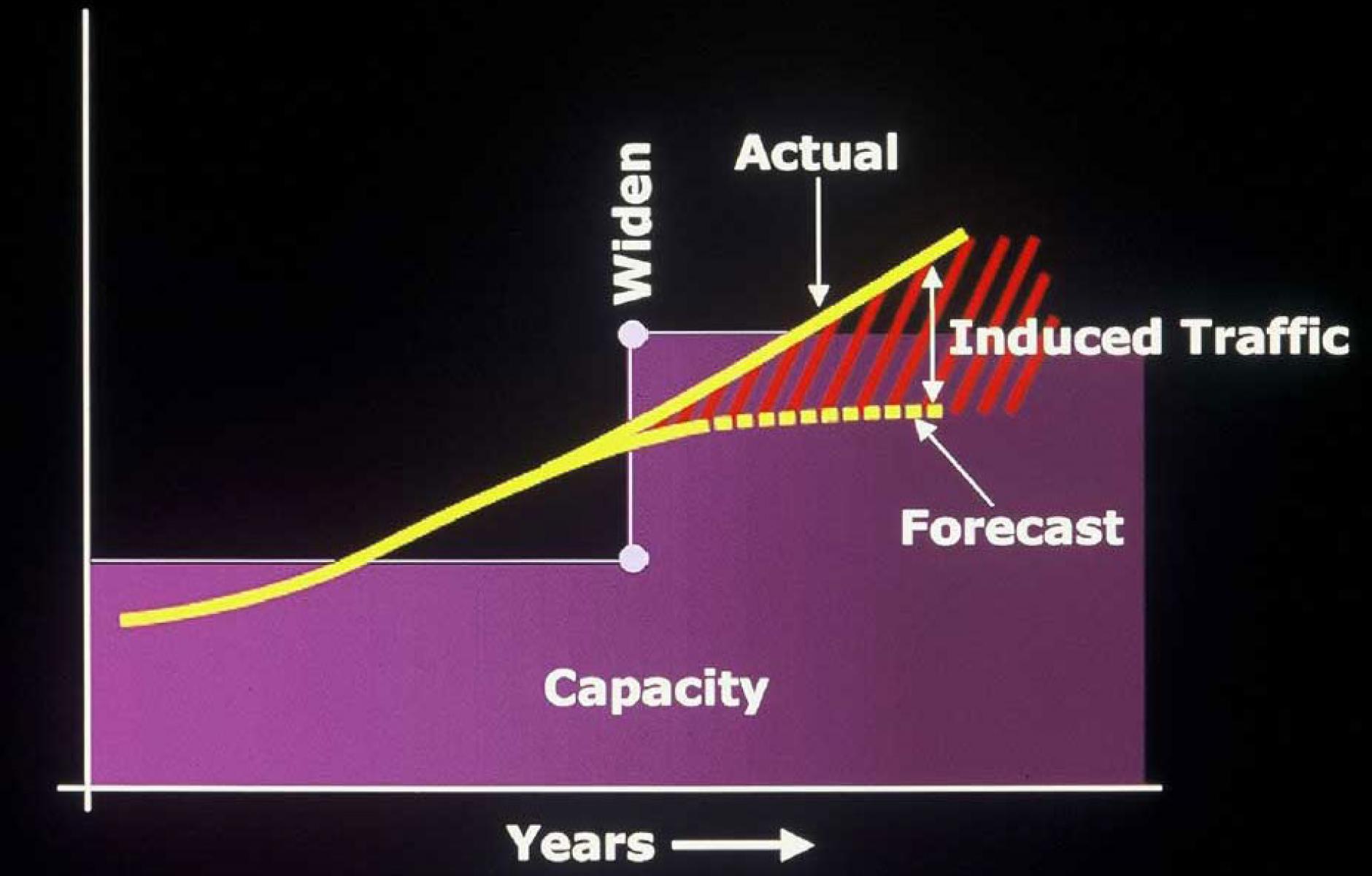
Induced demand is a well-known and generally acknowledged principle of road building, and may be summarized by the famous line from movie Field of Dreams: “Build it and they will come.” When substantial new road capacity is built, people will change their behavior—perhaps moving to a community further away from employment, taking advantage of the temporary excess road capacity. Over a few years, that excess disappears, and the new, bigger roads are just as congested as before—maybe decades in advance of when traffic studies had predicted the capacity would be exhausted.

In Walkable City, Jeff Speck describes induced demand as a “great intellectual black hole in city planning, the one professional certainty that everyone thoughtful seems to acknowledge, yet almost no one is willing to act upon.” That was 2012, and a growing number of transportation planners are willing to act upon induced demand. Not enough, but a growing number.

Induced demand. Source: Walter Kulash.

There is a concept that goes hand-in-hand with induced demand that transportation professionals rarely acknowledge exists, let alone act upon. It is called reduced demand. If road capacity is reduced, people will also change their behavior. 

Walkable City also mentions reduced demand, which is “what happens when when ‘vital’ arteries are removed from cities. The traffic just goes away,” Speck says. People may stop making certain trips, condense multiple trips into one, use alternative transportation options like walking, biking, or transit, or travel at different times of the day.

Are We Courage Enough to Apply..?


Cars are the Nightmares' of City Planners and Managers

Very inspiring presentations of a variety of different 'road diets'. These techniques could literally transform our 'traffic arteries'!
«There is a known-solution to inequitable, ineffective, and unsafe streets: redesigning those streets with changes that prioritize moving people over cars. What follows are five site studies that demonstrate what is possible when community-driven planning is catalyzed by technology.»
This week, we are released Shovel-Ready #NYC25x25 Streets, a new report showcasing five re-imagined New York City streets that prioritize people over cars. This project shows what more equitable, healthy and safe streets look like in each borough. This project shows that Streets for People can be a reality.
These five locations were selected based on traffic crash, bus speed, air pollution, tree cover, and asthma data. Each new design presents solutions for our streets that address these overlapping problems. The solutions were devised with input from residents and the expertise of planners, and are built upon the collaborative mapping technology of Remix, a tool from Via. This first-of-its-kind collaboration showcases the power of community input in creating streets for people and a new way to accelerate the work of reclaiming space from cars.
Seventy-five percent of New York City’s streetspace is dedicated to the movement and storage of vehicles. It is time to imagine a better use of our streets that puts people, not cars, first.
See the streets at https://buff.ly/31M17wG.

Monday, November 8, 2021

Certification


  • Do hear about (xxxxxx) Certification?
  • Yes, it is easy to get
  • I visited their website, and got confused with lots of materials and contents
  • You can go to the certification domain, and explore the process
  • I tried, but could not understand what to do
  • It is easy, to get the study materials
  • How?
  • Just register and download the PDF
  • I will MEMORIZE it all; in no time
  • Be aware; it is two levels; general and advanced
  • Means two exams?
  • Yes; however, you can get certified in two months
  • Please; help me to get into the process
  • Sure…
That is how certifications are downgraded for just memorization and job-hunting tool

Saturday, November 6, 2021

DOC, IOD, TOC, TOD, etc..


During the last few years, urban labs were very active across the globe, in search for the optimum solution for the urban sprawl and changes.. The demographic growth is imbalanced across most cities, while the grassroots of food supply are in jeopardy in few parts due to rural urban migrations. Yes, the monetary cycles and the unmerciful practice of investment had fed the media with manipulated messages on definition of urbanity and the citizenship as well..

Historically; Urbanity had been driven by (DOC)s; which are Defense Oriented Communities; where as security and solidarity were formalized in walled towns and provided or surrounding a Fort or a Citadel.. Not only to fortify against invaders, but also increase the social coherence among citizens.. It had been the key element to form government and administration that we know today..


Introducing the Infrastructure Oriented Development (IOD) was an urban and civil breakthrough; whereas Infrastructure became the label of decent living. It is confident to state that sprawl of urban settlements were driven by Infrastructure; which became the key goal and measure for the City Managers. This is where most of the city budgets are spend; allowing for cities to compete on excellence of living and styles.

Ironically, both regulated and slams neighborhoods share few of the key utilities, which make slums and non-regulated settlements a continuous urban pain. Utilities' providers gain a lot from connections and serving the inhabitants; regardless of their tenure status..


Vehicle Oriented Developments (VOD) are the curse of 20th century; that already stigmatizing our urban world; which also had disconnected and disfigured the cities. This phenomenon has lots of economic, political and administrative aspects, with mighty lobbies that superseded urbanists' rejection; if any.. Private Vehicles are synonymous to wealth and wellbeing that hard to change at the near future..

City Managers had used pedestrian bridges and underpasses to ease the connectivity across the hazardous roads, yet not welcomed by inhabitants. So far, no alternate or innovative ideas is seriously considered, while fatality rates are increased due to car accidents..


When Melbourne-2018 had brought to practice the 800 meters, or the famous 20 minutes City formula, it was labeled to "Live Locally"; where all citizen are given the ability to meet most of their daily needs within a 20-minute walk from home, with safe cycling and local transport options.

Certainly, work places are hardly to be included within that radius, but encouraging the younger generations for more start-ups and remote jobs. Such a vision will reduce the city transportation demand, and allow for self-sustained communities to grow..

The 20-minutes neighborhoods are the spearheads for transformation of the city; to restructure their communities into (TOC); Transit Oriented Communities. These TOC will reduce the inter-city transit demand; allowing for better environment and social coherence in a fast moving or transit world..


Tuesday, November 2, 2021

Project Control


Basically addressing the construction management and implementation of principles and techniques of project management. The context is most probably inapplicable to other fields to apply project management, such as financial operations, software development or healthcare services.

Among the main three pillars of project management; Time Control and Management is the most critical; whereas all others are collaborated in some way or another. Within Schedule; scope is developed, verified and changes, bringing time variations to the time baseline. Similarly, Cost are also embedded; as any unplanned variations of cost of materials or labor shall be create problematic situations for all parties; which in many cases would lead to slow progress or freeze.

Many project management software and applications compete to create comprehensive and easy-to-do Controls. The dominate culture would advise to collaborate the control techniques on the key three domains. It is an opportunity; yet a trap. This is one of the main reasons why software doesn’t have the driving force it should have on projects success. On the contrary; it might be a key cause for the project failure. The created confusion to balance deliberations against baselines and risks is overwhelming and destressing.


The Schedule Control should include the following processing:

  • Commencement is a rational discretion of the Contractor
  • Baseline breakdown into administered deliverables
  • Tracking the auditable (signed off) deliverables
  • Report on compliance to baselines
  • Compliance means closing out

The most efforts are on tracking the deliverables; which consumed more time as per the amounts of design flaws, comments, redo, changes and drafting errors. Experience tells that these efforts will dramatically increase by nature of contract between EPC and D&B. The number of peer reviewing layers will duplicate the work, such as in D&B contracts whereas the following layers will be there to audit and certify the design documents:

  • Urban Authority’s Engineer
  • Urban Utilities’ Engineers
  • Developer or Employer’s Engineer
  • Contractor’s Engineer
  • Supplier or Subcontractor’s Engineer

Usually, the Controls will be administered by the Design Managers as per the planned dates for submittals. It is standard that design stages shall be: Concept, Schematic, Detailed and IFC (Issued for Construction). Imagining communications and exchanged documents will be surprising; with the new communication digital media and applications. In a personal experience; a compound of 300 townhouse documents will generate during the design development more than 4000 documents throughout the design stages; with approximately 50,000 drawing sheets and document pages. Check Aconex.

Project Managers will create various templates and forms to records and track the deliverables throughout the project cycle. The templates will reflect the professional culture for data capturing and reporting. Not necessarily to interpret the data into graphics, unless found hard to comprehend by the audiences. However, Every PM will administer the template as per discretion, as how it will properly convey the data to the Employer. The key glimpse is about how comprehensive such template will unconditionally include and answer all questions and queries.


https://www.oracle.com/ae/industries/construction-engineering/aconex-project-controls/?bcid=5799409842001


Wednesday, October 27, 2021

Delhi

Delhi, India, contains approximately 16 million residents. The neighborhoods of Santosh Park and Uttam Nagar, both pictured here, are home to some of the city’s poorest people and contain its most built-up and densely populated land. Numerous studies have shown a correlation between the wealth of a residential area and its total number of trees and the amount of green space. This Overview is a particularly striking example of that trend.

https://bit.ly/3vGjFJQ


Saturday, October 23, 2021

Street Furniture


Somewhere; within our disturbed world; between ambitions and cultural taboos.. Street Furniture are considered "Facilitation of Prostitutions".. This freak notion comes from some disqualified City Managers; who happened to control the soul of the City and its Residents.. You may examine lots of silly ideas and implementations as such..; which in total hinder our urbanism..

Unfortunately, those ill-fated Managers forget that Street Furniture is a Right-to-City..!!


The socially unbeatable and oldest profession of the history; can not  be eradicate or diminish; yet it grows by many innovative ways with sprawl of cities and urbanism.. Many sturdies had worked on this issues, with no successful roadmap to get rid off.. 

Many City Managers had come to a conclusion to live with.. Just provide controls and permits to allow minimal disturbances to the conservative public.. and avoid or minimize the negative impacts on public entertainment, health and reputation.. However; the privacy of prostitution business drives the sex workers to use side and back streets rather than the main motorways..


The neueve concept of "Complete Street"; which had got support from Mobility, Greenish and Covid, had introduced interesting ideas of street furniture.. The brilliance of those ideas had saved the City Managers the cost of fights for the adequacy of street wellbeing.. Street Furniture are mostly commercialized by adjacent business owners; who would simply eradicate the prostitution from those streets by F&B prices and charges; in exchange of wider number of  "innocent" customers..