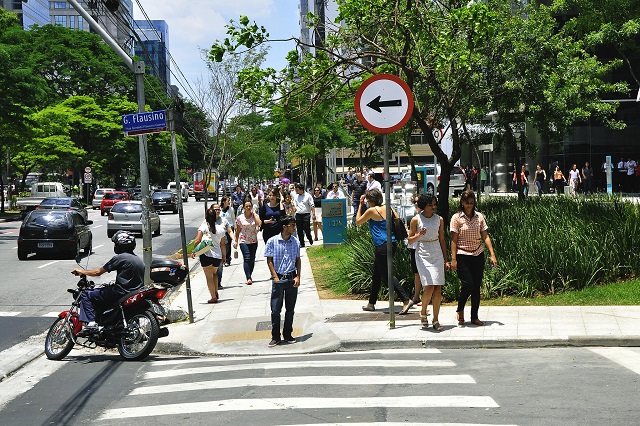
If done right, better sidewalks can lead to people-friendly streets and cities. Photo by Mariana Gil/WRI Brasil
By Hillary Smith and Paula Manoela dos Santos October 8, 2019
Walking is the oldest, most democratic way to get around. But as urban areas have become more sprawled, walking has slowly been suffocated by other modes of transport that are less healthy for both people and cities. Wide, congested roads have taken precedence over pedestrian sidewalks, crossings and public spaces. Too often, the pedestrian areas that do exist are poorly constructed and maintained.
WRI’s The 8 Principles of Sidewalks, now available in English, makes the case for shifting back to pedestrian-friendly streets. More people walking means fewer people depending on motor vehicles to get around, reducing transport emissions and strengthening individual health. A higher number of pedestrians also creates safer streets and brings more commerce to shopfronts. More broadly, walkable and people-centered public spaces enliven neighborhoods and foster positive urban coexistence.
While 8 Principles of Sidewalks was originally published in Portuguese by WRI Brasil, the issues it addresses around people-friendly public spaces are relevant to cities across the globe. The report is more than a technical guide for constructing safe, accessible and inviting sidewalks. It’s intended to inspire cities toward collaborative urban transformation – to show what’s possible when stakeholders work together under shared principles to reinvent an aspect of the city used by everyone and achieve higher quality of life for all.
These eight interconnected principles highlight the key elements to consider when designing city sidewalks and how they help promote more active, more livable cities:
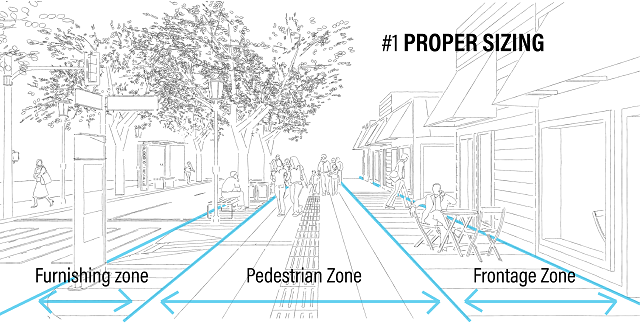
1. Proper Sizing
Elements:
- Sidewalk furnishing zone
- Sidewalk pedestrian zone
- Sidewalk frontage zone
Result: Provides enough space for people to use the sidewalk in a variety of ways: to walk, to socialize, to access buildings, etc.
A sidewalk’s furnishing zone, next to the street, can include urban furniture like benches and trees. The pedestrian zone, where people actually walk, should have no obstacles. The frontage zone often accommodates the furniture of commercial establishments and allows people to linger in front of buildings without disrupting the flow of those walking in the pedestrian zone.
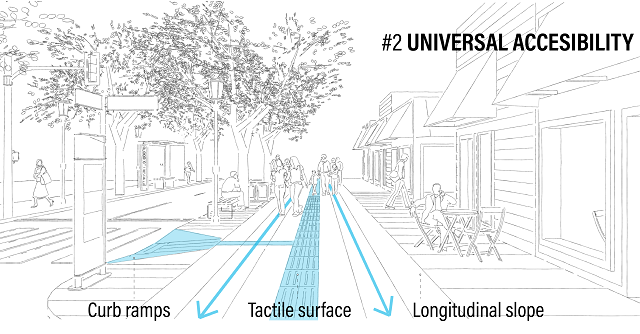
2. Universal Accessibility
Elements:
- Curb ramps
- Tactile surfaces
- Low-angle running slope
Result: Allows everyone access to an urban space.
The public sidewalk should be accessible to all, including wheelchair users, pregnant women, the elderly and others with special mobility needs. A sidewalk that is intuitive and easy to use incorporates curb ramps, tactile surfaces to help people with impaired vision, and a consistent running slope – or the slope of the sidewalk in the direction people walk – that isn’t too steep.
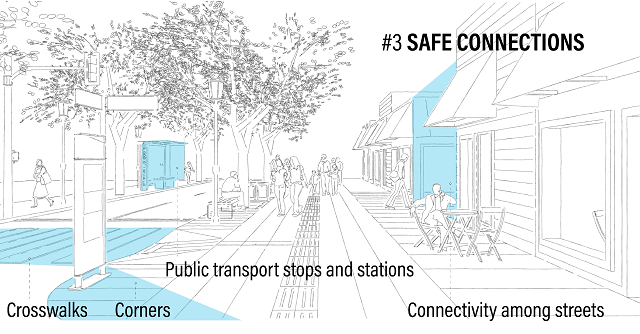
3. Safe Connections
Elements:
- Safe and accessible crosswalks, street corners, stairs, public transport stops and other urban spaces
Result: Ensures safe, continuous walking links to other means of transport.
Pedestrians walk on more than just sidewalks, and they often use multiple modes of transport. A city’s walking network should integrate safe, accessible connections among different urban spaces like intersections, alleys, stairs and public transport stations. This includes implementing safe street design principles, like shorter blocks and crosswalks, raised crossings, and traffic lights timed to pedestrians’ average walking speed. Sidewalks around transit hubs should also have enough space to avoid creating crowds and allow access for pedestrians with special mobility needs.
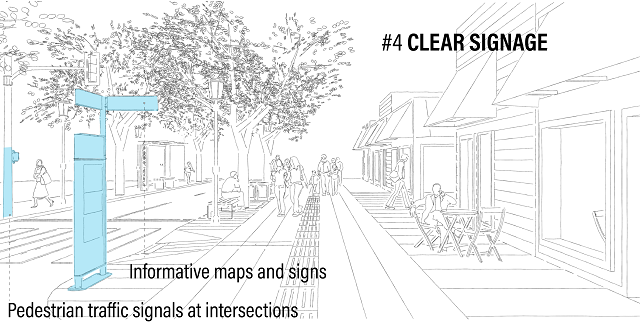
4. Clear Signage
Elements:
- Informative maps and signs
- Pedestrian traffic signals at intersections
Result: Promotes communication between people and the urban space.
Just like drivers of motorized vehicles, pedestrians need clear information so that they can both orient themselves in the city and understand the rules of particular sidewalks. Pedestrian-focused signage systems – including crossing lights, maps, walking times and directions to places of interest, and facts about the neighborhood or community – should be consistent, easy to find, and designed for people of all knowledge levels and skills.
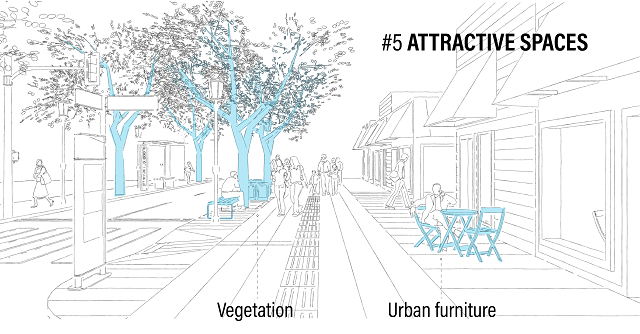
5. Attractive Spaces
Elements:
- Vegetation
- Urban furniture
Result: Provides an environment where people feel comfortable and encouraged to use the space.
Sidewalks can play a crucial role in making the urban experience more enjoyable and inspiring. The positioning and type of trees and urban furniture – from garbage bins to benches – can affect the ambiance and utility of a space. Vibrant, inviting sidewalks can also facilitate social interaction, further encouraging use of public spaces.
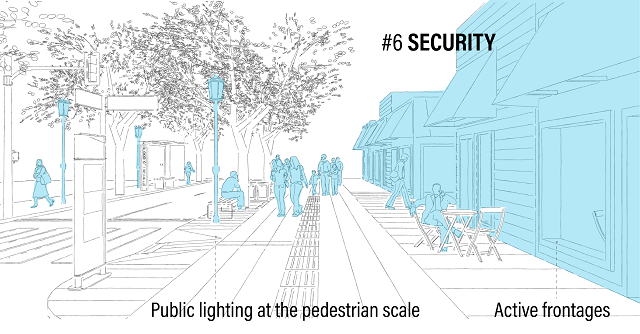
6. Security
Elements:
- Public lighting at the pedestrian scale
- Active frontages
Result: Invites people to occupy urban spaces more regularly and improves security.
Day or night, weekday or weekend, sidewalks are always open. However, there are fewer people out on foot during certain times of the day and week, leading to fluctuating safety conditions. Public lighting of pedestrian spaces improves personal safety at night. Active and transparent ground floor building frontages encourage more eyes on the street and more pedestrian activity at all times of day, making sidewalks more lively and secure.
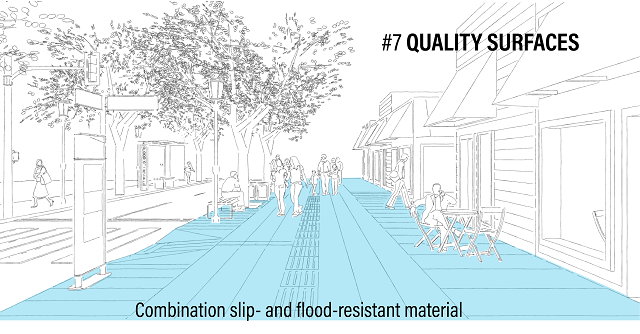
7. Quality Surfaces
Elements:
- Combination of stable, slip- and flood-resistant materials based on site needs
Result: Confers both comfort and safety while walking.
The material used to construct sidewalks needs to be consistent, stable, slip-resistant and designed to facilitate drainage. To build a well-functioning sidewalk, designers should select a combination of high-quality materials – including site-cast or porous concrete, cement tiles and others – based on the site’s needs.
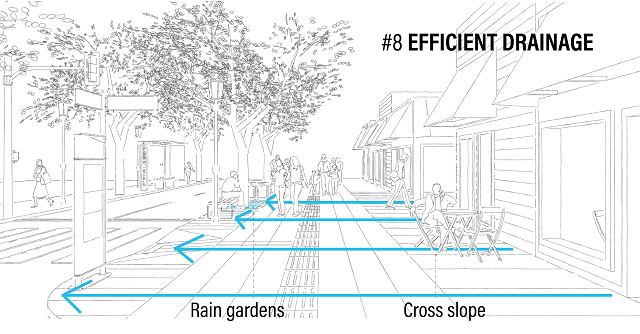
8. Efficient Drainage
Elements:
- Cross slope at appropriate angle
- Rain garden
Result: Fosters sidewalk resilience.
Waterlogged sidewalks can exacerbate urban flooding and property damage, and they quickly become useless to pedestrians, who end up diverting their routes through car-filled roads and risking their safety. The angle of a sidewalk’s cross slope – perpendicular to the running slope – should ensure efficient drainage without being too steep. Green infrastructure techniques like rain gardens can also help by reducing the volume of runoff and taking pressure off the drainage system.
Livable sidewalks following these principles can now be found in many cities in Brazil and around the world where city leaders have decided to move toward people-centered public spaces. Enhancing the quality of sidewalks is about prioritizing infrastructure for people instead of cars, giving the many ways we use the sidewalk the attention it deserves.
Download The 8 Principles of Sidewalks for more.
A version of this blog was originally published on WRI Brasil.
Hillary Smith is the Communications Assistant at WRI Ross Center for Sustainable Cities.
Paula Manoela dos Santos is the Active Mobility Manager at WRI Brasil.
8 Principles to Better Sidewalks | TheCityFix


In the realm of agile-based methodologies, the presence of project managers (in title) might seem like an anomaly. After all, agile promotes self-organizing teams and emphasizes collaboration over hierarchy, with the rise of roles like Scrum Master, Product Owner and so on.
However, the reality is that the skills and capabilities traditionally associated with project managers are still incredibly valuable in agile environments, even if the role title disappears or evolves.
Consider some of the most popular agile-based methodologies:
1. Scrum: While Scrum doesn't have a traditional project manager role, the Scrum Master serves a similar function. They facilitate the Scrum process, remove impediments, and ensure the team stays on track. In essence, they embody many aspects (not necessarily all) of project management, albeit under a different name.
2. Kanban: Although Kanban doesn't explicitly designate a project manager role, organizations often appoint a Kanban Manager or Flow Manager. These individuals oversee the Kanban process, optimize workflow, and address any bottlenecks that may arise. Their responsibilities closely align with those of a project manager, despite the absence of the title.
3. Extreme Programming (XP): XP embraces the role of a Coach or XP Manager. Like a project manager, they provide guidance, facilitate communication, and remove obstacles to the team's progress. Their focus on supporting the team's effectiveness echoes the core responsibilities of a project manager.
4. Lean Startup: In Lean Startup methodologies, the Product Manager or Product Owner plays a pivotal role in guiding the development and delivery of products or services. They manage stakeholders, prioritize features based on customer feedback, and oversee the project's direction—functions reminiscent of traditional project management.
While the titles may vary across agile-based methodologies, the essence remains the same: individuals fulfilling roles akin to project managers are integral to the success of agile projects. The expertise in planning, coordination, communication, and problem-solving that project managers bring to the table is invaluable in navigating the complexities of agile environments.
The adoption of agile-based methodologies doesn't negate the need for project management skills; rather, it reshapes and redistributes them across different roles. Whether it's facilitating teamwork, optimizing processes, or ensuring project success, the influence of project management endures in an agile landscape, proving its relevance in an ever-evolving professional landscape. Even if under a different name. Let's be adaptive!